Neutral guidance on prize-style and number-based games in Canada

PlayOnline is an independent, non-commercial resource. We explain how number draws, ball-based formats, dice-style games and wheel-of-fortune concepts generally work, so that adults can approach them with balance and awareness.

  • Informational only – no tickets, accounts or payouts.
  • Examples of number, ball, dice and wheel-style game formats.
  • Practical tips on limits, expectations and responsible play.

Content is general in nature and does not replace the official rules, terms or advice of any game operator or provincial authority.

Focus Number & prize-style
Audience Adults 18+ in Canada
Approach Neutral & informational

How to use this guide

  1. Review the general overview of prize-style concepts.
  2. Explore the three sample game formats with numbers, balls and dice.
  3. Read the responsible play section and FAQ before engaging with any real games.

Example game concepts

The three formats below are fictional examples designed to show how prize-style games with numbers, balls, dice and wheel elements might be structured. They are not real products and cannot be played on this site.

Snowfall Number Orbit

A drum of numbered balls plus a final orbit-style wheel.

Number balls Wheel segment Draw-based concept

General description

In this fictional format, a set of numbered balls is placed into a transparent drum. After a mixing phase, several balls are drawn to create a winning number combination. A separate orbit-style wheel is then spun to highlight an additional segment such as a bonus range or extra prize category.

Basic rules (illustrative only)

  • Participants would choose a small set of numbers from a clearly defined range.
  • The drum would be filled with physical balls printed with the same range of numbers.
  • A predetermined number of balls would be drawn to form the result.
  • The orbit wheel would be spun once to indicate an extra condition, such as a multiplier band.

Practical recommendations

  • Always read the official rules of the actual game you are considering.
  • Verify how many numbers must match and what combinations are eligible for any prize.
  • Set a clear time and spending limit before engaging with any draw-based activity.

Example scenario

Imagine a range of 1–40 where a person chooses 6 numbers. During the draw, 6 balls are extracted from the drum and the orbit wheel highlights one of four coloured bands. Only people who match enough numbers and whose selection falls in the highlighted band would qualify for a particular prize tier, according to the official structure of the real game.

Prairie Lantern Dice

A step-by-step dice path with fixed outcome tables.

Dice sequence Number paths Table-based outcomes

General description

Prairie Lantern Dice is a conceptual game that uses several dice to move along a numbered path. At each stage, the position reached on the path corresponds to a row in a payout table published by the operator of the real game.

Basic rules (illustrative only)

  • A path is marked with numbered lantern spaces, for example 1 to 30.
  • Two or more dice are rolled to determine how far the marker advances.
  • The final lantern number reached is used to look up an outcome in an official table.
  • Some paths may include neutral, enhanced or no-prize spaces.

Practical recommendations

  • Check how many dice are used and how the movement rules work in any real game.
  • Review the official table carefully to understand the range of possible outcomes.
  • Keep sessions short and avoid trying to “chase” any particular lantern number.

Example scenario

Suppose the path has 30 spaces and three dice are rolled on each round. If the total of all rolls moves the marker to lantern 18, the person would consult a published table where lantern 18 might correspond to a modest fixed prize, a non-winning result or another clearly described outcome.

Polar Prism Wheel

Segments, colours and number clusters on a rotating wheel.

Wheel segments Colour bands Number clusters

General description

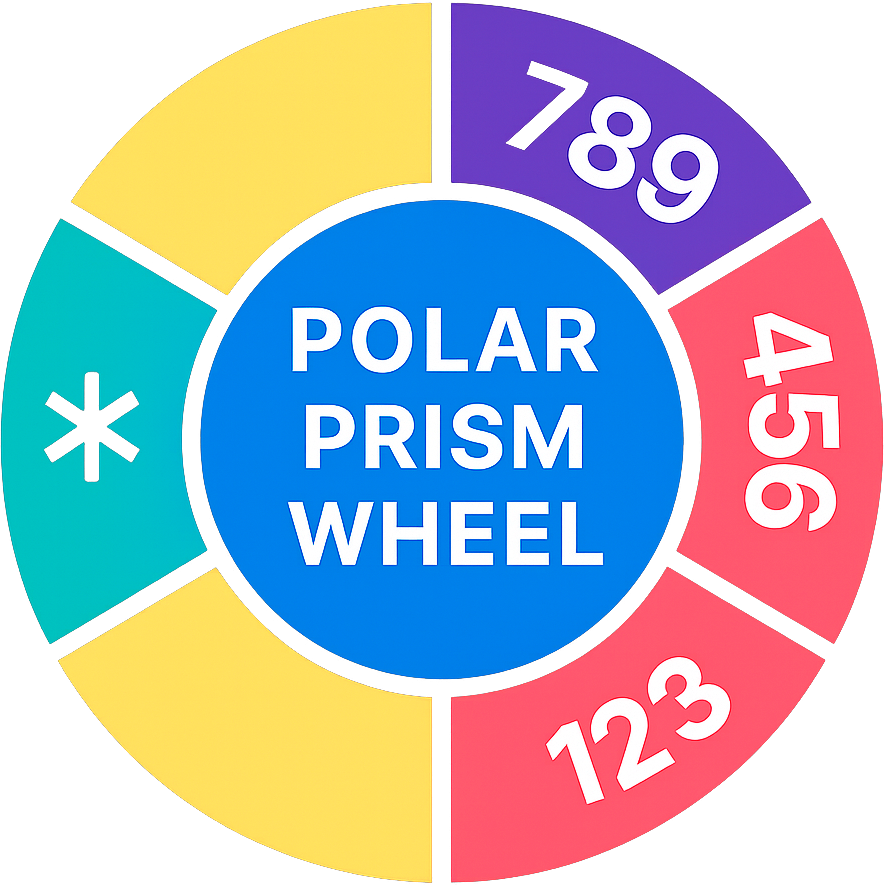
Polar Prism Wheel is an illustrative wheel-of-fortune style format. Each segment of the wheel contains a colour, a number cluster or a symbol linked to a clearly described outcome category.

Basic rules (illustrative only)

  • The wheel is divided into multiple segments with visible labels or colours.
  • Participants would select a segment type or combination as explained in the rules.
  • The wheel is spun and eventually stops, pointing to a single segment.
  • The outcome is determined by matching the selected segment type to the result.

Practical recommendations

  • Check how many segments exist and how often each segment appears.
  • Understand any difference between colour bands, number clusters and special symbols.
  • Remember that each spin is independent; previous spins do not influence the next one.

Example scenario

A wheel might have 48 segments split across four colour families. A person chooses one colour family in advance. When the wheel stops, it points to a segment. If it matches the chosen colour, the person would receive a fixed prize defined in that game’s official table. If not, the round would simply conclude.

General approach to number & prize-style games

Regardless of the specific format, a structured and cautious approach can help keep any interaction with prize-style or lottery-style games within healthy limits.

1. Understand the format

Read the official rules from the organisation that operates the real game. Focus on how numbers, balls, dice or wheel segments are selected, and how outcomes are calculated.

2. Set limits in advance

Decide how much time and money, if any, you are comfortable using for recreational play. Treat this as a leisure budget and do not exceed it.

3. Keep expectations realistic

These activities are designed as optional entertainment. They should not be viewed as a way to solve financial difficulties or generate regular income.

4. Pause regularly

Take frequent breaks and review how you are feeling. If play stops being enjoyable, or starts to feel pressured, it is a good time to step away.

Frequently asked questions

These answers are general and informational. For precise, legally binding details, always consult official provincial resources and the operator of any real game.

Does this website sell lottery tickets or run prize games?

No. This website does not sell tickets, operate games, hold accounts, process payments or distribute prizes. It provides neutral, high-level information about how number-based and prize-style formats may be structured, along with responsible play guidance.

Who is allowed to use this website?

The content on this website is intended for adults aged 18+ who wish to better understand how prize-style and number-based games generally work in Canada. People under 18 are asked not to use this site.

Are prize-style games legal in Canada?

In Canada, rules and regulations can vary by province and by game type. Government-operated lotteries and other authorised providers publish their own eligibility criteria, age limits and terms. This website does not provide legal advice. If you have questions about legality, consult official provincial resources or an independent professional.

How much time is reasonable to spend on these activities?

That depends on personal circumstances. A helpful starting point is to treat these activities like any other form of optional entertainment – for example a movie or small hobby – and to limit both time and spending so that essential commitments and savings are never affected.

What if I feel I am losing control of my play?

If you notice that play feels difficult to stop, is affecting your mood, finances or relationships, or is no longer enjoyable, it may be time to take a full break and speak with a trusted person or professional support service. The responsible play section below lists warning signs and suggestions on where to seek help.

Responsible play & wellbeing

Responsible play is about staying informed, setting boundaries and knowing when to step back. The aim is to keep prize-style games as an occasional, optional form of leisure – not a source of pressure.

Core principles

  • Use only money you can comfortably afford to lose.
  • Keep play occasional, not daily or constant.
  • Set clear time and spending limits before you begin.
  • Do not play when feeling stressed, upset or under the influence of alcohol or substances.
  • Avoid trying to “win back” previous losses.

Warning signs to watch for

  • Spending more time or money than planned on games.
  • Feeling irritated or anxious when not playing.
  • Hiding the extent of play from family or friends.
  • Using games to escape from everyday problems.
  • Missing work, study or other obligations because of play.

Steps you can take

  • Take a complete break from all prize-style or lottery-style games.
  • Review your budget and make sure essentials are fully covered first.
  • Speak with a trusted friend or family member about how you are feeling.
  • Replace play time with other activities such as exercise, reading or hobbies.
  • If concerns persist, reach out to a professional or helpline in your province.

If you need additional support

Every province and territory in Canada has information and support services for people who are concerned about their gambling or prize-style play, or about someone close to them. Many offer free, confidential phone lines, chat services and counselling options.

If you or someone you know is in immediate danger or experiencing an emergency, contact local emergency services right away.